
How to Improve SEO Ranking for Charlotte Businesses
Let's get straight to it. You’re running a business in Charlotte, maybe in South End or NoDa, and you just want more customers to find you on Google.…


Let’s get straight to it. You’re running a business in Charlotte, maybe in South End or NoDa, and you just want more customers to find you on Google. This isn’t about chasing algorithms or finding some secret trick; it’s about making a series of smart, deliberate choices rooted in the work we do for Charlotte businesses. SEO feels like this big, mysterious beast, but it’s really not. It’s a system. This guide is the playbook we use to make that system work for you. You don’t have to be a tech wizard. You just need a clear plan.
TL;DR: The 60-Minute SEO Plan
Don’t have time for a full teardown? I get it. Here’s the bottom line. Focus on the basics that give you the most bang for your buck.
- Decision: Am I showing up correctly on the map?
- Action: Go to your Google Business Profile. Make sure your address, phone number, and hours are 100% correct. This isn’t optional for local businesses; it’s central to our local SEO guide.
- Decision: Does my most important page actually say what we do?
- Action: Look at the title and first paragraph of your main service page. Does it clearly say what you do and for whom, using words a real customer would use? “Top-rated Dilworth plumber” beats “Synergistic piping solutions.”
- Decision: Am I answering a real customer question?
- Action: Write a simple, 300-word blog post that answers one common customer question. Just one. Title it “How To [Solve a Common Problem]”.
These aren’t glamorous fixes. They’re the small, disciplined steps that actually move the needle.
The First, Fastest Wins for Your Google Ranking
So you need to make a dent in your SEO, but you don’t have weeks to wait for results. This is about what you can fix in the next hour—the low-hanging fruit that actually moves the needle. Forget the massive, months-long project for a moment. We’re talking about targeted fixes that deliver an outsized impact. Quick wins are all about building momentum.
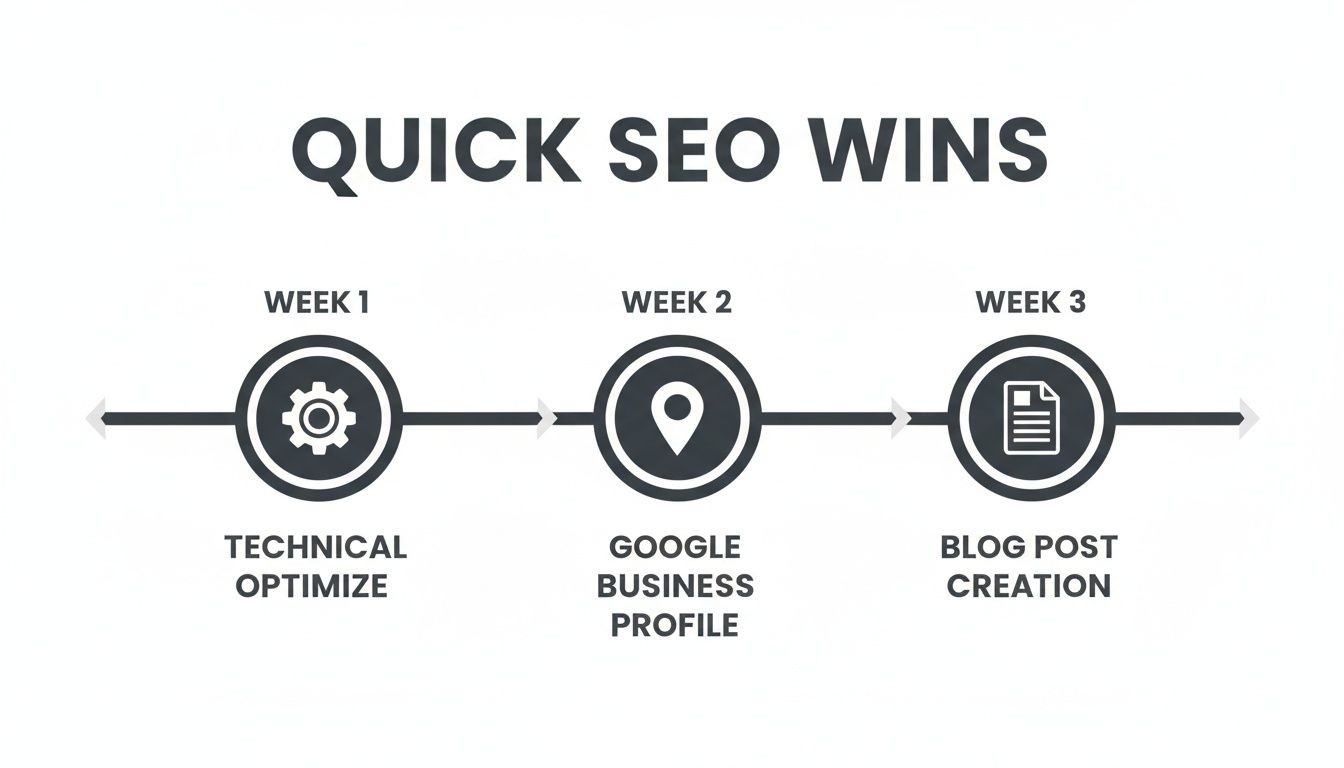
The idea is simple: focus on one high-impact area each week. Tackle some technical basics, then your Google Business Profile, then a piece of content. This approach stops you from getting overwhelmed and ensures you’re making tangible progress. Why is this a bigger deal than most people think? Because the top three positions in Google get nearly 75% of all clicks. For a business in Charlotte, that’s the difference between a phone that rings and one that doesn’t.
Your 60-Minute SEO Checklist
If you’re short on time, this checklist is your starting point. These are dead-simple tasks you can knock out in under an hour to give your site a quick boost.
| Decision: Do I Have an Easy Fix? | Action (Time Estimate) | Why It Matters |
|---|---|---|
| Is my page title any good? | Improve a Page Title (5 mins): Your title tag is a huge ranking signal. Make it more specific and compelling. | A better title gets more clicks, even at the same rank. |
| Do I have any giant images? | Compress a Large Image (10 mins): Large images kill page speed. A faster site ranks better and doesn’t annoy people. Check our tips on website speed. | Speed is a direct ranking factor. |
| Can I answer one more question? | Add an FAQ to a Service Page (10 mins): Answer a real customer question to capture specific search terms. | You become the helpful expert, which Google loves. |
| Is my Google profile complete? | Update Your Google Business Profile (15 mins): For local businesses, this is non-negotiable. Use this Ultimate Google My Business Optimization Checklist. | It’s the fastest way to show up for “near me” searches. |
Each one of these seems small, but together they start to build the foundation for better rankings. Don’t underestimate the power of chipping away at the small stuff.
Build Authority That Google and Customers Trust
Ranking high on Google isn’t just about stuffing keywords onto a page; it’s about earning the right to be there. You have to be seen as a credible, authoritative voice in your field. This is the long game of SEO, but it’s what separates businesses that stay on top from the ones that just fizzle out.
A huge piece of this puzzle is backlinks. Think of backlinks as votes of confidence from other websites. When another site links to yours, it’s signaling to Google, “Hey, these people know what they’re talking about.” So, how do you get them? It’s not about blasting out spammy emails. It’s about creating something so valuable that other businesses and publications want to share it.
Real-World Example: Proving You’re the Expert
Let’s say you’re a nonprofit in Uptown Charlotte focused on financial literacy.
- The Meh Approach: A blog post titled “Our Financial Services.”
- The Authority-Building Approach: A detailed guide called “A Starter’s Guide to Building Credit in Mecklenburg County.” You include real resources, link to local banks, and give genuinely useful advice.
Which one do you think a local news blogger or a community resource site is more likely to link to? The second one, obviously. It’s not about faking authority; it’s about proving it. This is where harnessing E-E-A-T with authentic storytelling becomes your most powerful tool.
Optimize for the Future: Be the Answer

The way people find information is being rewired. Right now. With AI chatbots and Google’s “AI Overviews” showing up at the top of the page, simply targeting keywords feels like bringing a knife to a gunfight. The new game isn’t about being on the list; it’s about being the answer.
This is the shift from SEO (Search Engine Optimization) to AEO (Answer Engine Optimization). The whole goal is to structure your content so directly and authoritatively that AI models have no choice but to quote you as the source. Smart Charlotte businesses are already moving on this. Why? Because visitors arriving from AI-driven search are worth 4.4x more in conversions and have a 27% lower bounce rate. That’s not just traffic; it’s better traffic that actually does something.
So the question is simple: are you going to be the go-to source, or just another blue link? The future belongs to businesses that provide definitive, citable answers. To dig deeper, you can check out our guide on how marketing teams win when search becomes answers.
How to Know If Your SEO Is Actually Working
You’re putting in the work. But how do you know if any of it is actually, you know, working? Let’s cut through the noise. You don’t need to become a data scientist to figure this out. The answer is in a couple of free tools: Google Search Console (GSC) and Google Analytics 4.
Simple SEO Success Metrics
Too many people get lost in a sea of data. Let’s simplify. Here are the core metrics that connect what’s happening in Google to what’s happening for your business.
- Are more people seeing us? (Impressions in GSC): This means your visibility is growing in search results.
- Are more people clicking? (Clicks in GSC): This shows your titles and descriptions are compelling people to choose you over competitors.
- Are they doing anything useful? (Conversions from Organic in GA4): This is the ultimate proof. Are search visitors filling out your contact form, calling you, or buying stuff?
Don’t overcomplicate it. If impressions, clicks, and organic conversions are all trending up, you’re on the right track. This means more phone calls, more form submissions, and more customers walking through your door in Ballantyne or Myers Park.
Common SEO Mistakes (and How to Sidestep Them)
It’s easy to get SEO wrong. We see the same mistakes trip up Charlotte businesses over and over. This isn’t about theory; it’s about saving you from the frustration we’ve seen sink otherwise good marketing plans.
- Mistake #1: Keyword Stuffing. This is a zombie tactic from 2005. It’s jamming your main keyword into a page repeatedly, thinking it proves your relevance to Google. It doesn’t. It just sounds weird and desperate.
- Instead of this: “We offer the best lawn care in Charlotte. Our Charlotte lawn care is top-rated. For Charlotte lawn care, call us.”
- Do this: “Our team provides reliable lawn care for families across Charlotte, from Myers Park to Ballantyne.”
- Mistake #2: Forgetting Your Other Pages. Your homepage is important, sure. But it’s not where the real action is. Your service pages, location pages, and blog posts are where you can address specific problems and capture customers who are ready to make a decision. A homepage can’t do all that heavy lifting on its own.
- Mistake #3: Ignoring “Boring” SEO. Things like site speed, mobile-friendliness, and broken links feel technical and unexciting. But they are the foundation. Google won’t rank a slow, broken site, no matter how great the content is. It’s like having a beautiful storefront with a door that won’t open.
Want the Roadmap Without the Guesswork?
Improving your site’s SEO isn’t about chasing every new trend. It’s about a deliberate, defensible plan that connects you with people ready to buy.
If you’re done with SEO that feels like a shot in the dark, let’s talk. We’ll give you a straight answer on what it takes to build a site that shows up, converts, and works as hard as you do.
SEO FAQs: Straight Answers for Charlotte Business Owners
We hear these questions all the time. SEO feels like a moving target, and you’re busy running a business. Here are the straight answers to the questions Charlotte business owners are actually asking.
How long does it really take to see SEO results?
Honestly? Anyone who gives you a hard date is selling you something. For quick wins, like fixing a page title, you might see a little bump in a few weeks. But for the kind of results that actually move the needle, you have to think in months, not days. SEO is a long-term play. It’s less like flipping a switch and more like planting a tree.
Do I need to blog to have good SEO?
Need to? No. Should you? Almost certainly, yes. A blog is one of the single best tools for proving your expertise. Every post is another chance to get found. A generic “Services” page is fine. But a blog post titled “How to Handle Mecklenburg County’s Hard Water Problems” answers a real, local question and attracts exactly the right kind of customer.
Is local SEO different from regular SEO?
Yes and no. The fundamentals are identical: you still need a fast site and good content. But local SEO adds a critical geographic layer. It’s all about claiming and optimizing your Google Business Profile, getting a steady stream of reviews from local customers, and being obsessive about your business name, address, and phone number being consistent everywhere online. For a boutique in South End, showing up in the map pack when someone searches “gifts near me” is everything.
Can I do SEO myself, or should I hire someone?
You can absolutely get started on your own. Frankly, just by reading this guide, you’re already putting in more thought than a lot of your competitors. The basics are doable. But there will come a point where you hit a ceiling. That’s the perfect time to bring in an expert. It can save you a ton of wasted time and get you unstuck fast.
Does social media affect my SEO ranking?
Not directly. A thousand likes on your Instagram post won’t magically make Google rank you higher. But social media is the megaphone for your content. It gets your brilliant blog posts in front of more eyeballs. If a local Charlotte blog or news site ends up linking to your site because they saw it, that backlink is pure gold for your SEO. Think of social as the distribution channel, not the ranking factor itself.
What’s more important: content or technical SEO?
It’s like asking what’s more important for a car: the engine or the wheels? You need both. All the great content in the world won’t matter if your site is slow and broken. And a technically perfect site with zero useful information is just a well-built ghost town. You have to work on both.